Solutions · Frying
A cobot cell beside the fryer you already own.
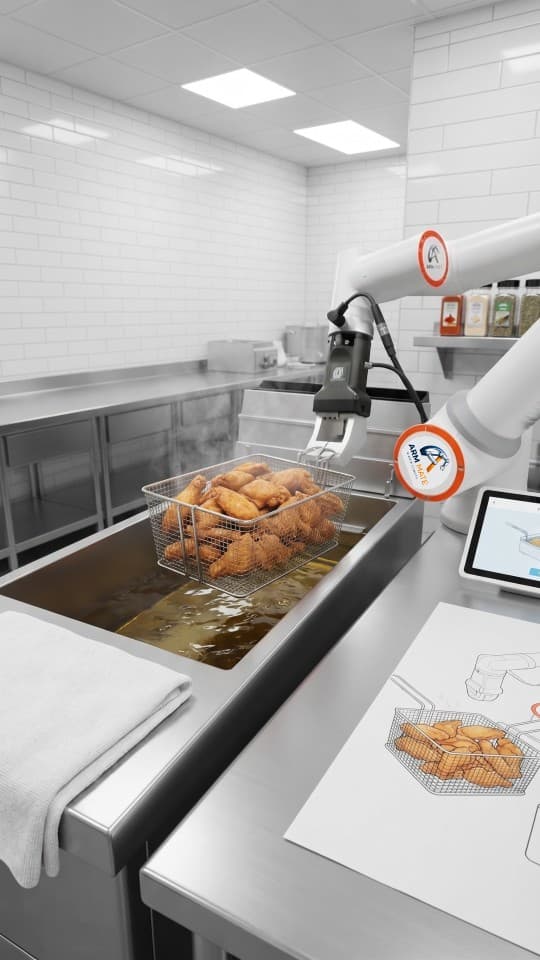
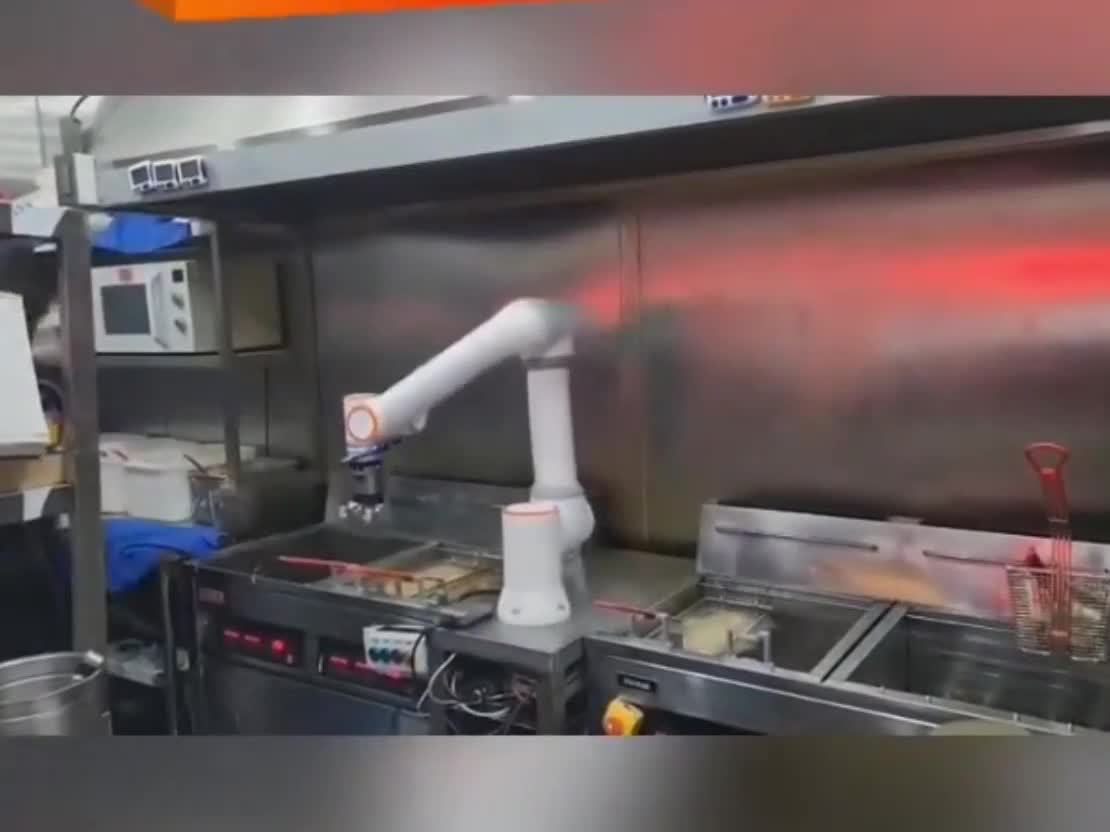
ArmMate retrofits a 6-axis cobot onto the fry station. The arm handles basket motion. Your oil, fryer, and menu stay in place.
The station problem
Fry stations lose consistency when the same person has to shake, drain, and drop baskets through a rush. Hiring around that one station is hard, and a full kitchen rebuild is rarely the right first move.
The retrofit
We put a pedestal or ceiling-mounted cobot beside the fryer. This is an integrator project: cell design, the tool on the wrist, safety, training, and support. The fryer stays.
Use cases
Fries
High-volume drops where the shake, the drain, and the timing have to match every basket.
Wings and breaded items
Stations that need a consistent shake so the cook stays even through the rush.
QSR and cafeteria lines
One fry station that sets the pace for the rest of the line.
Basket cycle
The exact path is programmed for your fryer and your menu. The shape of the cycle is this.
01
Pickup
The arm takes the basket from the rail or the dump side.
02
Lower
It sets the basket in the vat on a timed path.
03
Cook
The program holds the cook the recipe calls for.
04
Shake and drain
The arm lifts, shakes, and lets oil run off.
05
Present
The basket goes to the dump, holding, or the next cycle.
From the cell
What we deliver
Cell design
Layout, reach, and mounting for the fryer that is already in the line.
End effector and baskets
A wrist tool and basket interface matched to the product you fry.
Safety
A station review for people working next to the cell.
Training
Floor time with the crew that will run the station.
Support
A plan for remote help, maintenance, and on-site response.
Safety and standards
Each cell ships with a station risk assessment per ANSI/RIA R15.06 and ISO 10218, collaborative-operation validation per ISO/TS 15066 where applicable, documented e-stop and lockout/tagout procedures, and operator training.
Wrist tooling and basket interfaces are specified for the food zone. Washdown and heat-exposure ratings are confirmed per station. No food-safety certification is claimed unless stated in your proposal.
Questions buyers ask
- What does a cell cost?
- Every station is quoted fixed-scope after assessment. We do not publish a generic price.
- How long does it take?
- Planning ranges are on the how it works page. The assessment sets the real dates.
- What do we have to provide?
- Floor access, the fryer model, a lead operator, and a downtime window. Each phase names who signs off on safety.
- How do you accept the cell?
- Every install includes a site acceptance test against the cycle defined in your proposal before handover.
Request a frying assessment.
We will look at the fryer, the menu, and the space beside the station, then tell you if a cell fits.